
A good workshop does not start with hundreds of tools. It starts with the right few. The tools you actually reach for when something needs to be repaired, assembled, adjusted, cut, drilled, measured or tightened. That is the quiet difference between a room full of equipment and a workshop that really works.
When we talk about the most important tools for a workshop, we are talking about a practical system. Hand tools, power tools, measuring tools, safety gear and proper storage all have their place. If they are chosen well, even a small workshop can feel calm, capable and ready.
Essential workshop tools for everyday repairs
Every useful workshop needs a reliable basic tool kit. Not fancy. Reliable. A screwdriver set, pliers, hammer, adjustable wrench, socket set, tape measure and utility knife will solve more everyday jobs than most people expect. These are the tools that help with furniture assembly, shelf fitting, bicycle repairs, home maintenance and small mechanical tasks.
The products often shown in workshop images, such as screwdrivers, pliers, wrenches, hammers, drills, toolboxes and work gloves, are not there by accident. They represent the real working core of a practical workspace. You use them again and again because they cover the most common actions. Tighten, loosen, grip, pull, cut, measure, drill and fix.
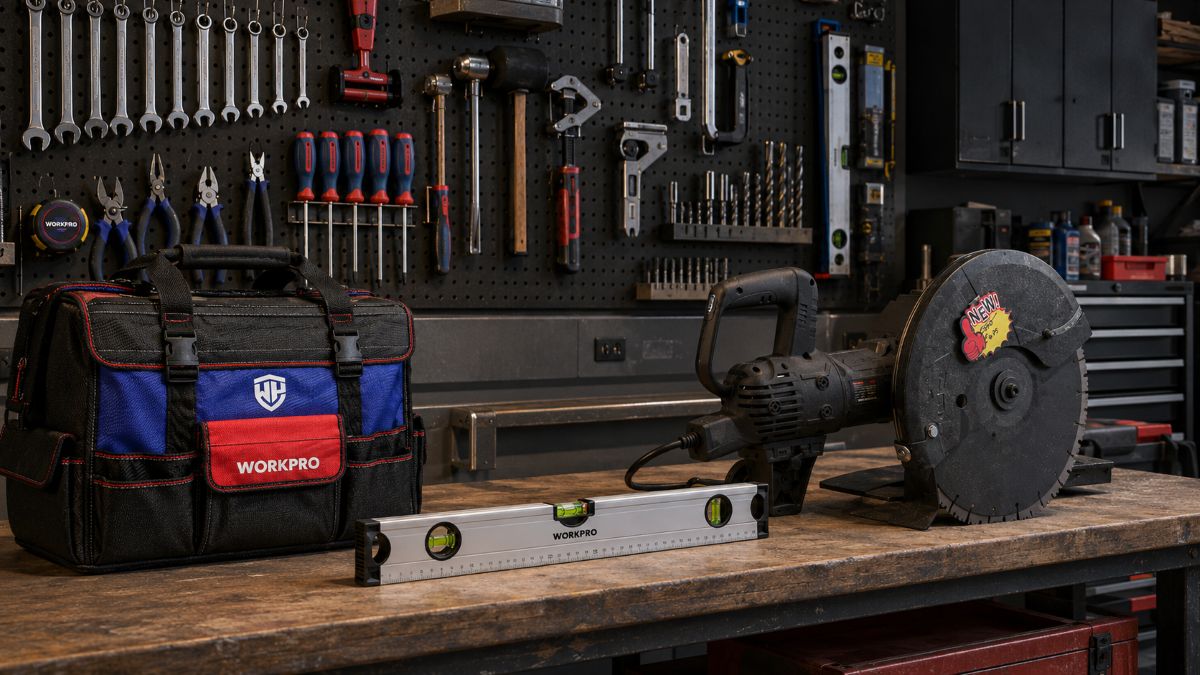
 WORKPRO 450mm Heavy Duty Rolling Tool Bag
View product
WORKPRO 450mm Heavy Duty Rolling Tool Bag
View product
 WORKPRO 200mm Aluminum Box Level
View product
WORKPRO 200mm Aluminum Box Level
View product
 TC 30535 Wall Chaser
View product
TC 30535 Wall Chaser
View product
A strong basic workshop setup may include
• screwdriver set
• combination pliers
• adjustable wrench
• socket set
• claw hammer
• tape measure
• utility knife
• cordless drill
• toolbox
• protective gloves
This is where I would start. Not with the rare tool you might need once a year, but with the tools that make ordinary jobs easier every week.
Hand tools that belong in every serious workshop
Hand tools still matter because they give you control. A screwdriver lets you feel resistance. Pliers help you grip awkward parts. A wrench gives direct force. A hammer does what no delicate tool can do. Simple tools, yes. But simple does not mean unimportant.
When choosing hand tools, look at the handle, the weight and the material. Cheap tools can work for occasional use, but in a real workshop they often become frustrating. A screwdriver that slips, pliers that do not grip properly, or a weak wrench can damage screws, bolts and surfaces. Then the cheap tool becomes expensive in a different way.
Keep these tools close to the workbench. A wall panel, drawer insert or well organised toolbox saves time. You do not want to search for the same wrench every time you need it. Small irritation becomes wasted energy. And in a workshop, order is not decoration. It is part of the work.
Power tools that make a workshop more efficient
A cordless drill is usually the first power tool worth buying. It drills holes, drives screws and handles many home and workshop tasks. Add a good set of drill bits and screwdriver bits, and suddenly the workshop becomes much more capable. For many people, this is the tool that changes everything.
After that, a cordless screwdriver, angle grinder and power sander can make sense depending on the kind of work you do. The angle grinder is useful for cutting and grinding metal. The sander helps with wood surfaces, renovation work and finishing. These tools save time, but they also demand more attention. Power is useful only when you control it.
Think in tasks before buying. Do you mostly work with wood. Do you repair metal parts. Do you assemble furniture. Do you maintain vehicles, bicycles or garden equipment. The answer decides which power tools you really need.
Measuring, marking and workshop organisation tools
Measuring tools are not exciting at first glance, but they prevent mistakes. A tape measure, ruler, square, spirit level and marker are basic workshop essentials. Measure twice and cut once. It sounds old because it is true.
Good marking also matters. A pencil, marker, chalk line or centre punch can make the difference between guessing and working accurately. In a workshop, accuracy begins before the cutting, drilling or fixing starts. It begins when you mark the job properly.
Organisation completes the system. Use a toolbox for portable tools, shelves for larger equipment, small boxes for screws and fasteners, and a wall holder for frequently used items. The better the layout, the less friction you feel while working.
Summary
The most important tools for a workshop are not always the most expensive ones. They are the tools that help you work safely, accurately and consistently. Start with strong hand tools, add a reliable drill, keep measuring tools close, and organise everything so you can actually find it.
A good workshop gives you control. You know what you have. You know where it is. And when a job appears, you are not starting from chaos. You are starting from readiness.
Meta description
The most important tools for a workshop, including hand tools, power tools, measuring tools, tool storage, screwdrivers, pliers, drills, hammers, wrenches and practical workshop setup tips.